What Is the Pomodoro Technique? The Rules, and How to Find Your Interval
The Pomodoro Technique is a simple time-management method: focus for 25 minutes, then take a 5-minute break, and repeat. The only tool you need is a timer. Used all over the world, it’s a proven fix for wandering focus and procrastination.
This guide covers the basic method first, then the thing most people actually get stuck on: “25 minutes doesn’t work for me.” How to choose between 15, 50 and 90 minutes, and how to stop your breaks from swallowing the afternoon.
What it is, and where it came from
The Pomodoro Technique is a time-management method created by Francesco Cirillo in the late 1980s while he was a university student. "Pomodoro" is Italian for tomato — the name comes from the tomato-shaped kitchen timer he used.
The story goes that it started as a bet with himself: could he genuinely concentrate for just ten minutes? That origin matters. The method does not assume heroic stamina; it assumes almost anyone can focus for a short stretch. Miss that, and it turns into one more thing to fail at.
The basic rules: 25 minutes focus + 5 minutes break
A single cycle looks like this. There is nothing to set up.
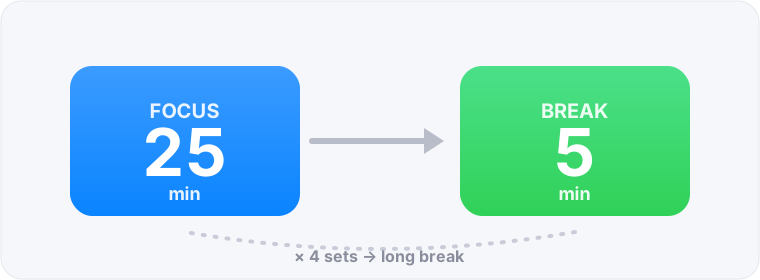
- Choose one task (not "study" — "50 flashcards")
- Set a 25-minute timer and work only on that task
- When it ends, take a 5-minute break (that’s one Pomodoro)
- After four rounds, take a longer 15–30 minute break
Why short intervals raise focus
Pomodoro doesn’t give you more willpower. It removes the conditions that were eating your focus, using nothing but a boundary in time. The effect breaks down into four parts.
- The deadline effect: "finish it today" is too far away to move you. “25 more minutes” is something you can feel.
- Attention recovery: focus is consumed. Resting *before* it runs out means the next round starts faster than if you’d pushed to empty.
- Less task-switching: the one-task-per-round rule forces down the cost of switching, which is where a surprising amount of the day goes.
- Visible progress: the number of rounds you finished is a record. On a bad day, being able to contradict "I got nothing done" with a number is worth a lot.
Running your first one
Theory helps less than one real cycle. Do these four things.
- Silence your phone and put it out of sight — ideally in another room
- Pick one task and clear everything unrelated off the desk
- Start a 25-minute timer. If something comes to mind, write one line and keep going — don’t act on it
- When it ends, take a real 5-minute break. Get away from the screen
When 25 minutes doesn’t fit: choosing your interval
25/5 spread because it’s a length most people can hold, not because it’s correct. When people give up on this method, it’s rarely willpower — it’s that the interval doesn’t match them.
Use these as starting points. If you’re cut off just as you get going, go longer. If you spend the back half watching the clock, go shorter.
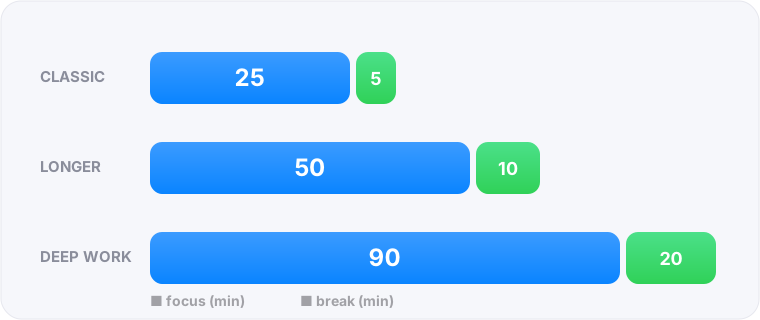
| Interval | Who it suits | Watch out for |
|---|---|---|
| 25 / 5 | The default. Easily distracted; flashcards, admin, anything you can chop up | Deep work gets cut off right as it gets going |
| 50 / 10 | Writing, coding, design — anything with a long warm-up | The break has to grow too. Five minutes won’t carry the next fifty |
| 90 / 20 | Deep work on a day when you actually have the runway | Starting at 90 cold usually fails. Build up from 50 |
| 15 / 3 | When 25 is too much: tired days, heavy tasks, restless days | Short isn’t cheating. Finishing the round is the whole point |
Stopping breaks from running long
The part that breaks first isn’t the focus — it’s the break. Five minutes turning into thirty on your phone is not a character flaw; it’s a structural problem, and it happens to everyone.
Three fixes. Put a timer on the break too. Keep your phone out of arm’s reach while resting. And set a rule in advance: if your break time is creeping past half your focus time, shorten the focus side. Fifty minutes of work followed by forty of "resting" gets less done than two rounds of 25.
Common mistakes, and the fix
When this stops working, it’s almost always one of these.
- Panicking over a task that won’t fit in 25 minutes → the task is too big. Not "write the report" but “draft the headings”
- Staring at work during the break → your brain doesn’t rest, and the next round is shallower. Physically stand up
- Breaking off to handle something you remembered → write one line, deal with it after the round
- Chasing round counts → the count is a result, not a target. If a round feels empty, change the length instead
Finding your own ratio in a week or two
The right length varies by person and by task. Run a two-week experiment: week one entirely at 25/5, week two trying long (50/10) and short (15/3) depending on the work. The pattern shows up quickly.
In FocusBlock you can set focus from 1 to 90 minutes, breaks from 1 to 30, and 1 to 8 rounds, all in one-minute steps. You can settle arguments as fine as "50 or 45," which is exactly what this experiment needs.
Pomodoro FAQ
Does it have to be exactly 25 minutes?
No. 25/5 is just the standard. Use 50 for deep work, 15 when you’re scattered — whatever length you can run to the end of. FocusBlock sets focus from 1 to 90 minutes and breaks from 1 to 30, in one-minute steps.
Why is 25/5 the default?
It spread as a length most people can hold without burning out — short enough to start, long enough to get somewhere. There is no hard evidence behind the exact number, so adjusting it to suit you is entirely reasonable.
Can I use 50 or 90 minutes?
Yes. Work with a long warm-up — writing, coding, drafting — suits longer blocks. Just scale the break with it. Fifty minutes of focus followed by five of rest tends to fall apart around the third round.
What if I can’t last 25 minutes?
Drop to 15 or 10. What matters isn’t the length but the experience of reaching the break without breaking focus. Start where you can finish, then add five minutes at a time.
Does the Pomodoro Technique work for studying?
Yes. Because you can split work by subject or topic, it pairs well with exam prep. Vary the length by material: 15–25 minutes for memorization, 25–45 for anything that needs thinking.