Studying With Pomodoro — High School, College and Exams
"I looked up and I’d been on my phone." "I start studying and it never lasts." A Pomodoro timer helps with exactly this: 25 minutes on, 5 minutes off, repeated, keeps both focus and momentum alive.
This guide starts with the basic loop, then covers exam timetables, writing a college paper, and studying in a library or café. Jump to whichever matches your situation.
Why cutting it into 25 minutes works
A Pomodoro timer repeats "25 minutes of focus → 5 minutes of rest" as one round. Short boundaries make it easy to think "just 25 minutes", and that’s usually all it takes to sit down.
Notice what it changes: not the *amount* of studying, but how easy it is to begin. "Three hours today" is heavy enough to stop you. "25 minutes" is not. And once you’ve sat down, the second round usually follows on its own.
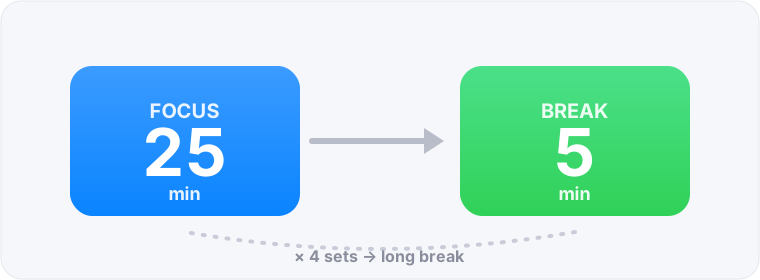
The basic loop, in three steps
There isn’t much to it.
- ① Pick one subject (vocabulary, practice problems)
- ② Start 25 minutes and don’t touch your phone
- ③ Rest 5 minutes, then go again. A 15–30 minute break after four rounds
How long per subject
The best length changes with the material. There’s no reason to give every subject the same 25.
- Memorization (vocabulary, dates, terms): 15–25 min, more rounds
- Reading and maths, anything requiring thought: 25–45 min
- Past papers and drills: 50 min to match exam conditions
- When you’re sleepy: drop to 15. Finishing beats defending the number
Beating the phone
Your phone is the biggest single threat, and "resist it" is the least reliable defence. Anything in view takes attention, so removing it physically is the only approach that holds.
- For the 25, notifications off and the phone out of reach (face-down on the desk is not enough)
- Anything you remember gets one line in a note and waits
- No social feeds during breaks either — they leave you worse at restarting
Building an exam timetable
Before a test, the time disappears into deciding what to do first. Two causes: the syllabus is too big to start on, and long unbroken sessions collapse. Both are solved by splitting rounds by subject.
The key is planning in rounds, not hours. "Three hours today" is impossible to grade honestly. "Four rounds of English, four of maths" has a clear end.
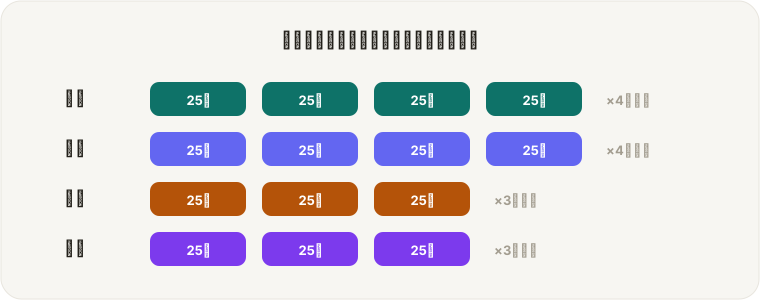
- Memorization subjects (vocabulary, history): 15–25 min, more rounds
- Understanding subjects (maths, science, comprehension): 25–45 min each
- e.g. weekdays 2 English / 2 maths / 1 history = 5 rounds; double on weekends
The final stretch, and past papers
Close to the exam, weight your rounds toward weak areas and likely questions. Covering everything thinly moves your score less than concentrating where the marks are. Order the rounds by what pays.
For past papers, a longer single round of 50 minutes to match real exam timing works well. Rest five minutes, then use the next round for marking and review. Splitting "solve" from "fix" is what gets you to actually review — skip it and past papers become busywork.
College: cut the paper into single rounds
Most university work is done alone against a deadline. With no external pressure, “I look up and nothing has happened” is the default failure. Here too, the 25-minute timer stands in as the missing pressure.
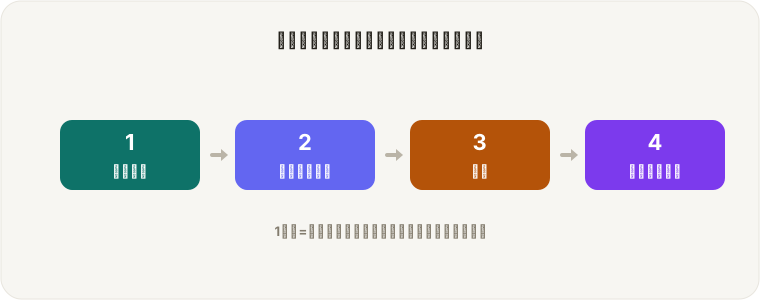
"Write the paper" is too large to begin. Split it into things that fit in 25 minutes: “read three sources,” “draft the headings,” “write the introduction.” One round, one task, and starting gets dramatically easier.
Libraries and cafés
Changing location helps focus, and this method travels well.
- Library: you can’t make noise, so a timer you can see is ideal. Mute the alerts
- Café: mild background noise helps some people. One sip per round keeps breaks from stretching
- Decide your round count before you leave, and you can start the moment you sit down
Breaks that beat drowsiness
A break means fully leaving. Sitting still with your phone isn’t one.
- Stand up and move a little; look at something far away
- If you’re sleepy, close your eyes for five minutes, or study standing
- If you use caffeine, drink it at the start of a break (it takes 20–30 minutes to work)
Studying — FAQ
Is it free for students?
Yes. FocusBlock is completely free with no sign-up, on a phone or a computer, straight from the browser. There is nothing to purchase.
How many rounds a day?
Four to six on a school day and eight to twelve at weekends is a reasonable target. Doing a sustainable number every day beats forcing big sessions — the weekly total usually ends up higher.
My plans never survive contact with reality.
Plan in rounds rather than hours, and roll anything you miss into tomorrow. Don’t chase a perfect record; count the rounds you finished and let that be the score.
The paper is too big to start.
Cut it into 25-minute pieces: read three sources, draft the headings, write the introduction. One task per round. Make the target a number of rounds rather than finishing the thing.
Can I use it in a library?
Yes. A silent, screen-only timer won’t disturb anyone. FocusBlock’s sound can be turned off, leaving the countdown and the stack of blocks to show your progress.