Memorization With Pomodoro (Vocabulary and Terms)
If vocabulary won’t stick, the method may be the problem rather than you. Running 15–25 minute rounds with frequent review raises how much survives, considerably.
This guide covers how to structure a single round and how to space your reviews. The goal is less time staring at a word list and more words that actually stay.
Why short rounds beat long ones here
Memory responds better to short, repeated exposure than to long grinding sessions. Rounds of 15–25 minutes stay sharp throughout, and the break afterwards gives what you just learned time to settle.
There’s a second, quieter benefit: the boundary creates the opportunity to review. Working continuously, you never naturally return to earlier material. Split into rounds, and the start of each one becomes an obvious place to go back.
How to run a memorization round
A good round opens with review and closes with new material. That order means yesterday’s batch gets one more pass, every single time, without planning it.
- ① Spend the first 2–3 minutes on a light pass over last time’s material (just looking is fine)
- ② Learn the new batch for 15–25 minutes
- ③ After the break, open the next round by checking the previous batch again
Recalling beats re-reading
This is where the efficiency really moves. Reading a list and feeling like you know it is not the same as covering the answer and retrieving it. The same minutes produce very different retention.
Retrieval feels harder and more tiring than reading — and that difficulty is precisely what strengthens the memory. Make the back half of every round a self-test with the answers hidden. "I recognize it" and "I can produce it" are different skills.
Spacing reviews before you forget
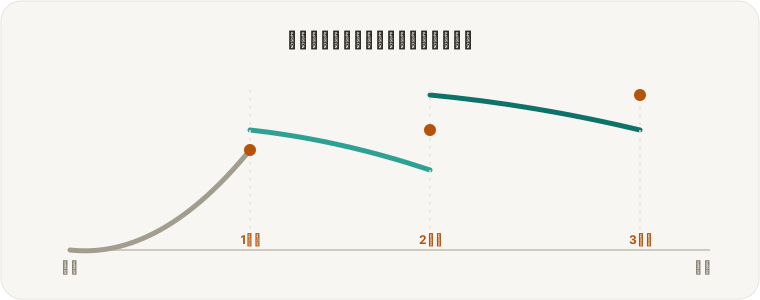
Material sticks when it’s reviewed before it fades. A workable pattern is same day → next day → a few days later, widening the gap each time.
Using the top of each round for review gives you the first of those three automatically. That leaves only two to plan, which makes the whole schedule far easier to keep.
Memorization fits the gaps
This is the one kind of studying that thrives on fragments of time.
- Treat 15 minutes of a commute or a break between classes as one round
- Even in a flashcard app, putting a boundary on the time holds attention better
- Finish the day with a light pass before sleep (memory consolidates overnight)
When it isn’t going in
If a batch refuses to stick, change the method rather than adding effort.
- Say it aloud or write it — more senses, better encoding
- Learn it with an example sentence or an image, not the definition alone (bare words have nothing to catch on)
- Pull the stubborn ones into a separate list. Far more efficient than looping the whole set
- Phone in another room. Notifications are especially destructive here
By subject
Even within "memorization," what gives the material something to catch on changes with the subject. Four common cases.
| Material | Round length | What works |
|---|---|---|
| Vocabulary | 15–20 min | Learn it inside a sentence. Word-to-definition alone won’t fire when you meet it in real text |
| Older or foreign grammar | 15 min | Keep a separate list for meanings that shift. Sort by can translate / can’t |
| History and science terms | 20–25 min | Learn the sequence and the causes, not isolated names and dates |
| Formulas | 25 min | Don’t memorise — use. Derive it once and you can rebuild it after forgetting |
Keep a record of the volume
Memorization is the hardest kind of studying to see progress in. Test scores lag by weeks, so the volume itself is worth recording to keep from giving up in between.
In FocusBlock, typing "vocabulary" before you start means the time accrues to that topic automatically. After a week, "3 hours on vocabulary" is proof you’re moving, even before any score does.
Memorization — FAQ
What length works best for memorization?
Short rounds of 15–25 minutes. Frequent exposure beats long sessions for retention. FocusBlock sets any length from 1 to 90 minutes in one-minute steps.
Should I try to learn it perfectly in one go?
No. Reviewing the same material later that day, the next day, and a few days after retains far more than one perfect session. Cut the volume per round and raise the number of passes.
I forget everything immediately.
Switch from reading to self-testing with the answers covered. Opening every round with a recall pass over the previous batch builds the first review into your routine automatically.
Is studying before sleep effective?
A light review pass is worth doing. It suits going back over what you covered that day rather than learning new material — and it stops being useful the moment it costs you sleep.